
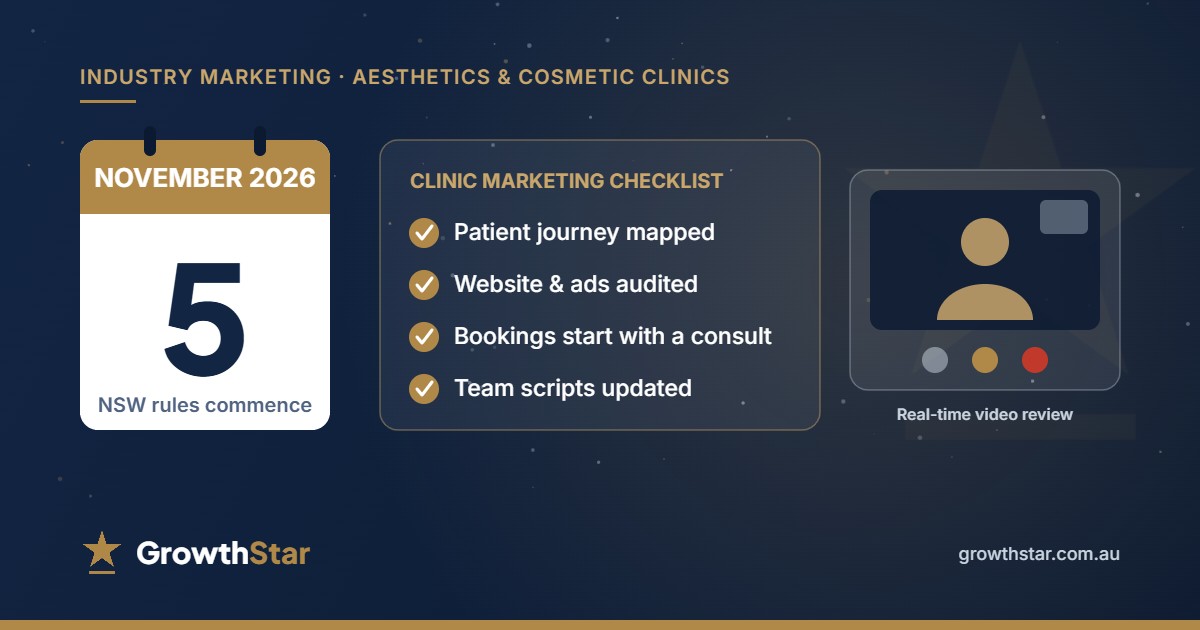
From 5 November 2026, new NSW medicines laws change how cosmetic injectables can be prescribed, administered and recorded. Most of the attention has gone to the clinical requirements, but the changes reach well beyond the treatment room. They reshape the patient journey your marketing feeds into, from the first ad someone sees to how they book. For NSW clinics, the days before the start date are a good time to check that the two line up.
What’s changing in NSW
The Medicines, Poisons and Therapeutic Goods Act 2022 and Regulation 2026 commence on 5 November. NSW Health describes “cosmetic use substances” as Schedule 4 (prescription-only) medicines used for cosmetic procedures, including botulinum toxins, dermal fillers and deoxycholic acid. According to NSW Health’s guidance:
- Only medical practitioners and nurse practitioners can prescribe or give a direction to administer these substances.
- Before prescribing or issuing a written direction, the prescriber must personally review the patient, in person or via video consultation.
- Written directions are valid for six months and must include specified patient, prescriber, substance, treatment-area and frequency details.
- Nurses must keep a written record of each administration, and businesses must keep copies of directions and administration records for two years.
- The business owner or operator, the “responsible provider”, must ensure procedures comply, risk management policies are in place, emergency equipment is available and nurses are trained to respond to medical emergencies.
- Penalties range from 20 to 400 penalty units for individuals and 100 to 2,000 penalty units for corporations.
The responsible-provider obligations matter for marketing teams and non-clinical owners in particular. Compliance is no longer only the prescriber’s problem; it sits with the business.
How this fits with Ahpra and TGA rules
The NSW laws add to national rules already in place. Ahpra’s guidelines for non-surgical cosmetic procedures, in effect since 2 September 2025, strengthened the ban on influencer testimonials, require advertising to include information about the practitioner performing the procedure, aim to stop procedures being trivialised or sexualised, and ban advertising aimed at people under 18.
Separately, prescription-only medicines can’t be advertised to the public under the Therapeutic Goods Act. The TGA has updated its guidance on advertising cosmetic injectables and on advertising therapeutic goods on social media, and law firm Clayton Utz notes that non-specific terms such as “wrinkle reducing injections” are no longer permitted, with the TGA expecting businesses to review historic social media posts too. The TGA has also published enforcement examples, including infringement notices totalling $7,716 issued to an individual over counterfeit botulinum toxin and unlawful advertising.
What it means for your marketing and booking journey
Taken together, the direction is clear: the consultation and the practitioner are what you market, not the product. In practice that means:
- Booking flows built around a consultation. Any journey that implies a patient can book straight into an injectable treatment, or be approved through a questionnaire or text exchange, needs rethinking. The prescriber review must happen in person or by video before prescribing.
- Capacity for video consultations. If your model relies on remote prescribers, make sure scheduling, reminders and technology support real-time video reviews without long waits that lose patients.
- Messaging that leads with expertise and safety. Practitioner credentials, assessment, suitability and aftercare are both compliant and persuasive, and they suit a market where patients are increasingly cautious.
- A clean content footprint. Website pages, Google Business Profile, social posts and old campaigns, hashtags, paid ads and affiliate or influencer content all form part of your advertising.
- Systems that match the record-keeping rules. Your booking platform and CRM should make it easy to keep directions and administration records for two years, and to handle patient information in line with privacy obligations.
- Front-desk and DM scripts. Reception and social media staff often answer “how much is…” questions. Give them approved wording that steers to a consultation.
A practical checklist before 5 November
- Map the patient journey from first ad to treatment and mark where the prescriber review happens.
- Audit your website, Google Business Profile, social accounts and active ads for product names, product-specific terms, pricing tied to injectables and influencer content.
- Update booking pages and confirmation messages so they describe a consultation with a named practitioner, not a treatment.
- Check that remote prescribing arrangements use real-time video and that confirmation is recorded.
- Confirm your systems can store directions and administration records for two years.
- Brief your team on what they can and can’t say, online and on the phone.
- Track consultation-to-treatment conversion so you can see the effect of the changes and adjust.
This article is general information, not legal advice. Check the requirements with NSW Health, your professional indemnity insurer or a legal adviser, and note that NSW Health says further information on compliance notices and penalties will be published later.
Clinics that treat compliance as part of the patient experience, not a constraint on it, will build the trust that keeps patients coming back.
We help clinics build marketing that is compliant, credible and commercially effective. Learn more about our work with aesthetics and cosmetic clinics, or contact us to review your patient journey before the changes start.
Sources
- Cosmetic use substances, NSW Health, updated 6 July 2026
- Medicines, Poisons and Therapeutic Goods Regulation 2026, NSW Legislation
- What tighter cosmetic prescribing rules mean for telehealth patients, Mirage News, 16 October 2026
- New cosmetic procedure guidelines, Ahpra, 3 June 2025
- Referring to cosmetic injectables in advertising, Therapeutic Goods Administration
- TGA injecting new life into renewed cosmetics guidance, Clayton Utz, 4 June 2025
Let’s talk
Want to apply this in your business?
A free 15-minute discovery call is the easiest way to explore where growth, marketing or AI could make the biggest difference for you.