
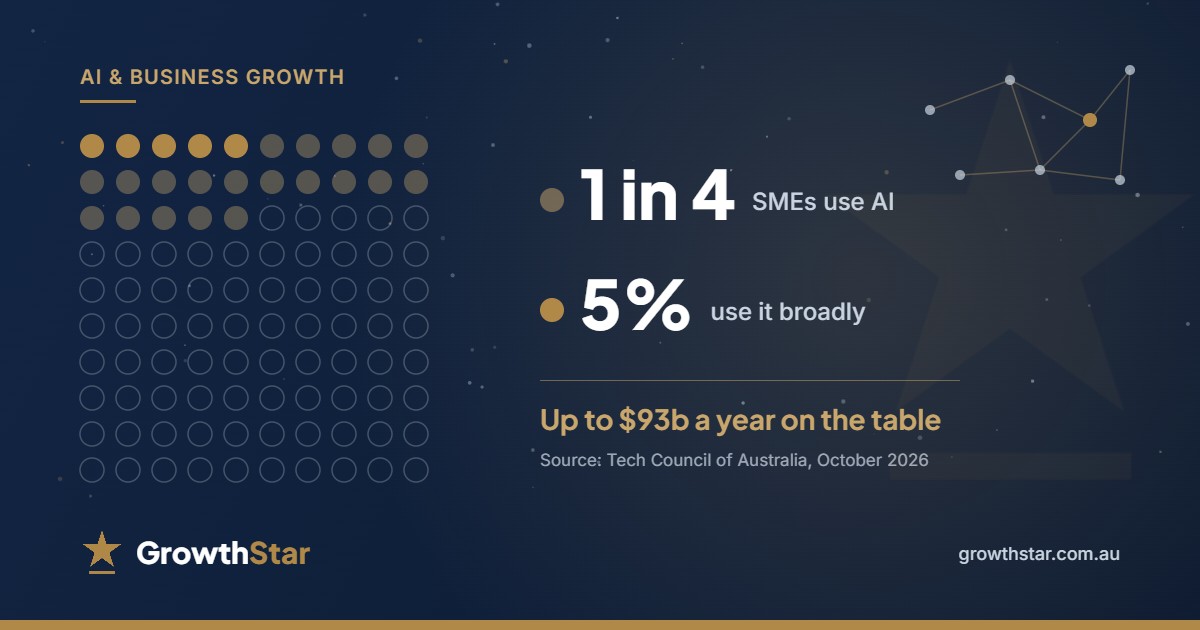
On 22 October the Tech Council of Australia released new research suggesting small and medium businesses could add up to $93 billion a year to the economy through wider use of AI. The headline number will get the attention, but the more useful figure for business owners is a gap: around one in four SMEs use AI, yet only 5% have adopted it broadly across their organisation. That gap, between trying AI and getting real value from it, is where most established businesses sit today.
What the report found
The report, Accelerating AI Impact for Small and Medium Enterprises, was undertaken by Delwood Advisory for the Tech Council, with support from Employment Hero, Google and Deputy and data contributed by Deputy, Xero and LinkedIn. According to the Tech Council’s release:
- SMEs could add up to $93 billion in annual economic value through wider AI use.
- An average SME moving from no AI use to broad adoption could gain around $136,000 a year in productivity.
- About one in four SMEs use AI, but only 5% have adopted it broadly.
- Research cited in the report found 94% of SMEs using AI reported productivity improvements, and 54% of employees using AI reported better job satisfaction.
- The main barriers are limited understanding of AI, workforce skills gaps, uncertainty about return on investment, and concerns about security and reliability.
- Regional businesses lag metropolitan ones, and construction, hospitality and retail show some of the largest gaps between SMEs and larger enterprises.
Two notes of caution. First, the $93 billion and $136,000 figures are modelled estimates of potential, not a forecast for any single business, and the release doesn’t set out the assumptions behind them. Second, several supporting partners sell software to SMEs. Neither point makes the research wrong, but it is a reason to treat the numbers as a signal of direction and build your own business case from your own data.
Why “using AI” and “getting value from AI” are different things
Depending on how it is measured, AI adoption among Australian SMEs looks very different. The National AI Centre’s AI adoption tracker, which surveys SMEs regularly, found that 43% of Australian SMEs reported some level of AI adoption between December 2025 and February 2026. The Tech Council puts current use at around one in four and broad use at just 5%.
The difference is mostly about definitions, and it tells a familiar story. In many businesses a few people use a chatbot to draft emails or summarise documents. That is useful, but it is individual and informal: no one owns it, there is no measure of the time saved, and the gains disappear when that person leaves. Broad adoption looks different. AI is built into specific workflows, someone is accountable for it, staff are trained, and the business can say what it has gained.
Where the value usually sits for an established SME
The report points to routine administration as the clearest opportunity, with examples such as payroll and rostering in hospitality and recruitment in retail. For most established SMEs, the best first candidates share three traits: the task happens often, it takes meaningful staff time, and a mistake can be caught before it reaches a customer. Typical examples include:
- Preparing first drafts of proposals, quotes, reports and marketing content for human review.
- Triaging and routing customer enquiries, and drafting responses for staff to approve.
- Summarising meetings, calls and long documents into actions.
- Pulling regular performance reports together from systems you already use.
- Rostering, scheduling and onboarding paperwork.
Notice what is not on the list: fully automated decisions about customers, pricing or people. Those may come later, but they carry more risk and need stronger controls.
A sensible 90-day plan
- Find out what is already happening. Ask your team which AI tools they use and for what. Unofficial use is common, and it is the fastest way to see where demand and risk already sit.
- Pick two or three workflows and measure them first. Record how long each one takes today, how often it happens and what errors cost. Without a baseline you cannot tell whether AI has helped.
- Put light-touch guardrails in place. The National AI Centre’s Guidance for AI Adoption: Foundations recommends a named owner for AI, a short AI policy, a simple register of the AI systems you use, human oversight matched to the risk, and telling customers when AI is used in ways that affect them.
- Protect personal information. The Office of the Australian Information Commissioner’s guidance on commercially available AI products makes clear that privacy obligations apply to personal information entered into AI tools, and recommends against putting personal, especially sensitive, information into publicly available generative AI tools.
- Go carefully with AI agents. If you are considering tools that act on your behalf, the Australian Cyber Security Centre’s Careful Adoption of Agentic AI Services advises starting with clearly defined, low-risk tasks, limiting access to sensitive data and systems, and setting points where a person must approve an action.
- Train, measure and decide. Give the people doing the work practical training on the chosen workflows, compare results against your baseline after 60 to 90 days, then scale what works and stop what doesn’t.
Common pitfalls to avoid
- Starting with the tool rather than the problem. A new subscription doesn’t fix an unclear process.
- Skipping the skills piece. The report lists skills gaps as a key barrier, and a tool nobody is confident using won’t be used well.
- Assuming headline averages apply to you. Use the $136,000 figure as a prompt to look for value, not as a target.
- Treating governance as a later problem. A one-page policy and a register take a few hours and prevent much bigger headaches.
The opportunity isn’t to use more AI. It is to move from scattered, individual use to a few well-chosen workflows that are owned, measured and safe.
If you’d like a structured view of where AI could make the biggest difference in your business, our AI enablement and consultancy services start with exactly this kind of workflow and risk review. You can also get in touch to talk it through.
Sources
- Small business AI could add $93 billion to Australia’s economy, Tech Council report finds, Tech Council of Australia, 22 October 2026
- AI could lead to $136,000 productivity gain each year for SMEs, SmartCompany, 22 October 2026
- Letting AI act for you? Australian guidance says start small, Dynamic Business, 21 October 2026
- AI adoption insights: December 2025 to February 2026, National AI Centre
- Guidance for AI Adoption: Foundations, National AI Centre, October 2025
- Guidance on privacy and the use of commercially available AI products, Office of the Australian Information Commissioner, updated 17 January 2025
- Careful Adoption of Agentic AI Services, Australian Cyber Security Centre
Let’s talk
Want to apply this in your business?
A free 15-minute discovery call is the easiest way to explore where growth, marketing or AI could make the biggest difference for you.